
00Hook
Stop measuring for reporting.
Start measuring for learning.
Most teams track velocity, story points, and burndown charts. The numbers go up. Nothing changes. Those metrics measure activity, not learning.
The teams I studied (ING, Spotify, Booking.com, bol.com, About You) did not start with dashboards. They started with one honest question: what do we actually want to learn?
Two downloads. Ten minutes to start. Zero spam.
01The pattern
Your metrics answer the wrong question.
Here is what I keep seeing.
A team tracks fifteen metrics. They report them every two weeks. Nobody acts on them. The dashboard exists because someone asked for it once.
No learning question behind the number. No check whether the team is ready to hear the answer. No small test to run with it.
Just a number on a slide.
The real problem is not the metrics. It is the system around them.
02The shift
What the fastest learners do instead.
The teams that ship faster (and learn faster) do not collect more numbers. They collect fewer, better questions.
Before they look at any dashboard, three things are settled.
- A learning question
- A specific thing they want to learn — not a number to admire.
- Honest readiness
- A team calm enough to look at the answer, even if it stings.
- A small next test
- A short experiment they can run if the answer surprises them.
Get those three right, and the metric almost doesn't matter.
03The framework
Every useful metric answers three questions.
If one side is missing, do not start measuring.
Start there.
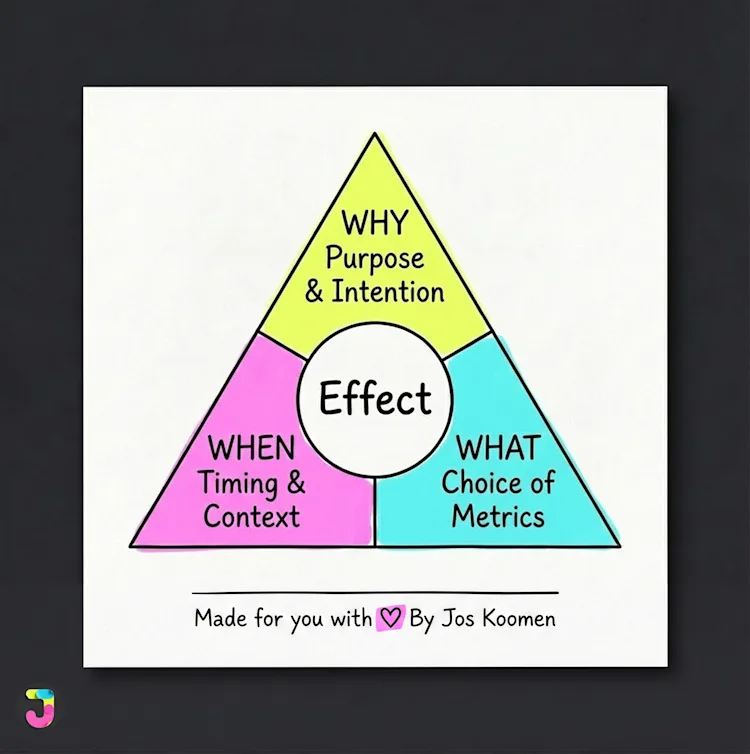
- A
- Why.
- What do we actually want to learn? And the uncomfortable one — what will we change if the answer hurts?
- B
- When.
- Are we calm enough to look at this together? Honest enough to not spin it?
- C
- What.
- What is the smallest test that teaches us the most?
Small tests. Short loops. Real conversations.
04The practice
Use this in fifteen minutes.
One full lap around the triangle. Bring it to your next retro and watch what changes.
- 01Step 01
Pick one metric you already track.
Velocity, cycle time, NPS... Whatever your team is already watching.
- 02Step 02
Place it inside the Triangle.
Define why it matters and what action it should trigger.
- 03Step 03
Open the Metrics Universe.
Add one companion metric for outcome, quality, or team health.
- 04Step 04
Bring both to your next retro.
Ask one question: What did we learn, and what will we change?
05The artefacts
Take it with you.
Free. No email required. Two artefacts to start building a better measurement system today.
PDF · One page
Measurement Triangle
The thinking framework that connects what you measure to why you measure it, and how you act on it. Visual. Immediately usable.
Get the Triangle →
Notion · 85 metrics
Metrics Universe
Eighty-five metrics organised by category, plus lightweight guidance to choose the right ones. If you have ever argued about story points, this will feel like fresh air.
Open on Notion →
Want the thinking behind it?
The Metrics Universe is built on proven measurement frameworks. Read the essay for the story and examples. Get in touch if you want help applying this in your context.